
 研报速递
研报速递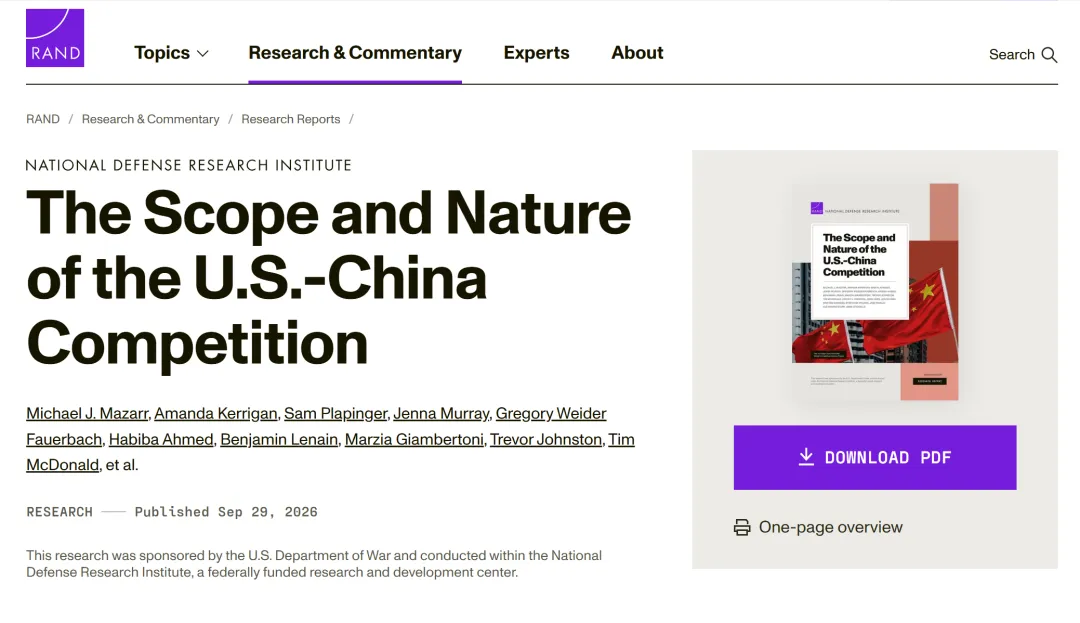
编者按:美国知名智库兰德公司官网9月29日发布了由美国战争部主持、国防研究院承担的研究报告,标题为《美中竞争的范围和性质》。该报告是一项预计为期两年的系统研究的首期成果。报告虽将中美互称“对手”(rival),但认为双方之间的竞争并非零和博弈,双方都不以分输赢为目标,在竞争的同时将进行合作(cooperation),至少是不回避协调(coordination)。这个基调判断无疑很令人鼓舞,小编长舒一口气,连身边的猫咪也明显受到感染,惬意地哼了两声。报告具体列举了竞争的七个领域,及决定竞争成败的两个关键赋能条件(system and network dynamics与society and governance)并进行初步分析,话题的选择和编排,行文的字里行间,必然透露很多有关美国主流社会与智识(没错,是智识,不是“知识”)界之态度、思想、关注等的诸多信息,值得中美关系的利益相关者或对中美关系抱有探究兴趣的人士研究。
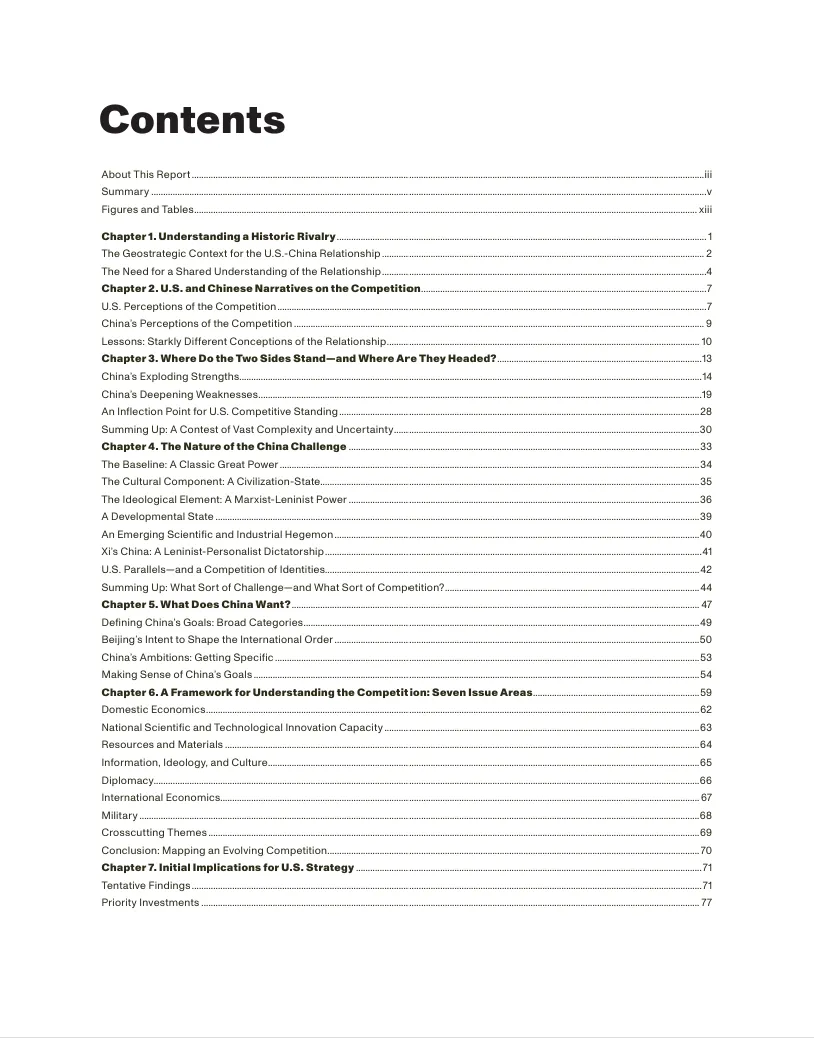
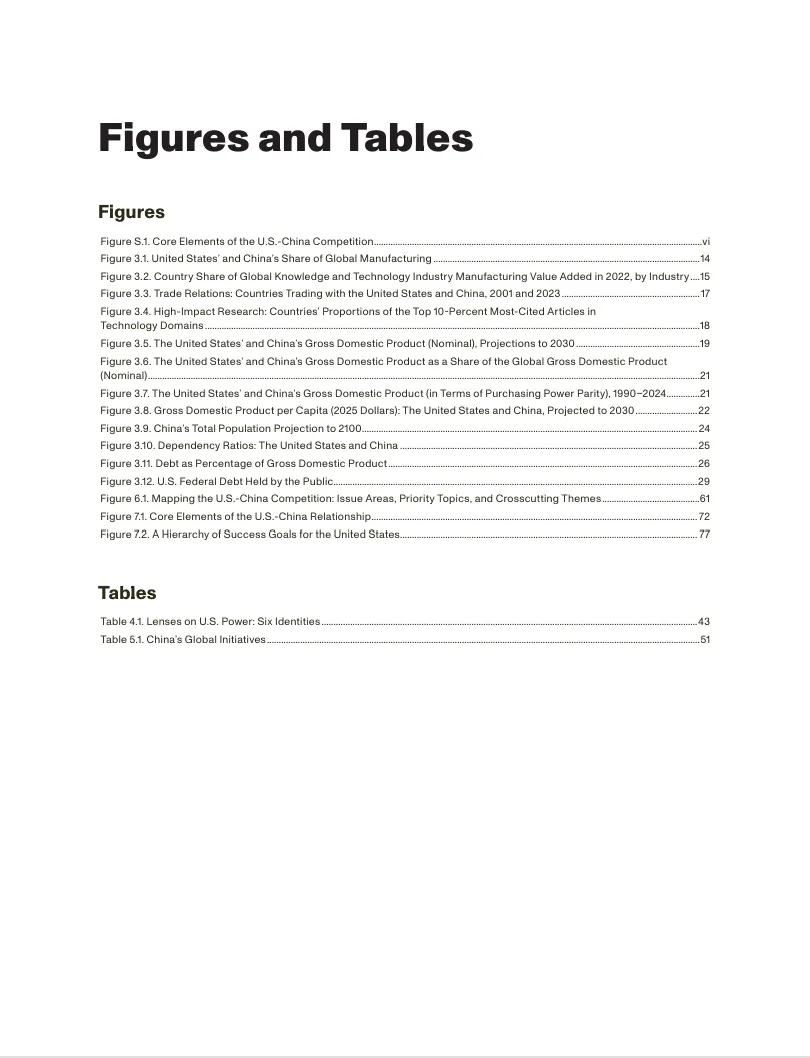
(报告目录)
以下是兰德公司官网对该研究报告的介绍,为保持全貌,小编干脆将其整版端上。
The Scope and Nature of the U.S.-China Competition
Michael J. Mazarr, Amanda Kerrigan, Sam Plapinger, Jenna Murray, Gregory Weider Fauerbach, Habiba Ahmed, Benjamin Lenain, Marzia Giambertoni, Trevor Johnston, Tim McDonald, et al.
ResearchPublished Sep 29, 2026
This research was sponsored by the U.S. Department of War and conducted within the National Defense Research Institute, a federally funded research and development center.
Significant debates remain underway on some of the most essential aspects of the U.S. contest with China: the nature of the competitor, the main elements of the competition, a sense of what the competition is truly about, what success looks like, and a theory of success to bring about that end. What is clear is that the United States is dealing with a rival whose dynamism derives not from ideological expansion but from economic development, a growing influence in international institutions and processes, and an increasingly strong position in the fields of science and technology.
The competition is clearly something other than a classic power transition; China is rising relative to the United States but not in a straight-line trajectory. China is not set to dominate world politics. Although China is immense and influential, its horizons are not infinite, and its power is counterbalanced by a variety of factors.
This report is the first of several deliverables in a RAND study on U.S.-China competition, and in this report, the authors offer a clear framework for understanding the elements of the competition and placing that framework in a broader conception of the competition’s nature. To build such a conceptualization, the authors reviewed U.S. and Chinese concepts of national power and statecraft and reexamined earlier RAND research on competition. The authors share their findings and deliver initial recommendations for how the United States can devise a strategy to counter China and gain strategic leverage in the competition.
Key Takeaways
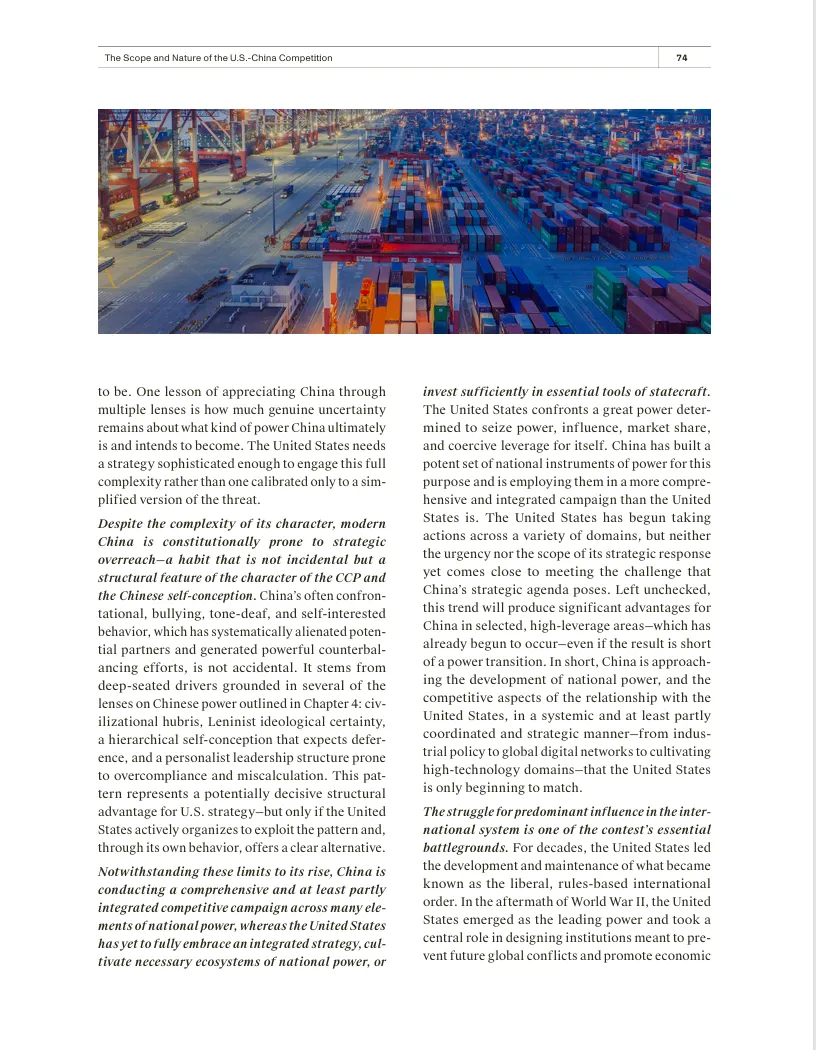
·China is conducting a comprehensive and at least partly integrated competitive campaign, both within and across many elements of national power; however, the United States has yet to fully embrace the contest’s scope or invest sufficiently in critical tools of statecraft.
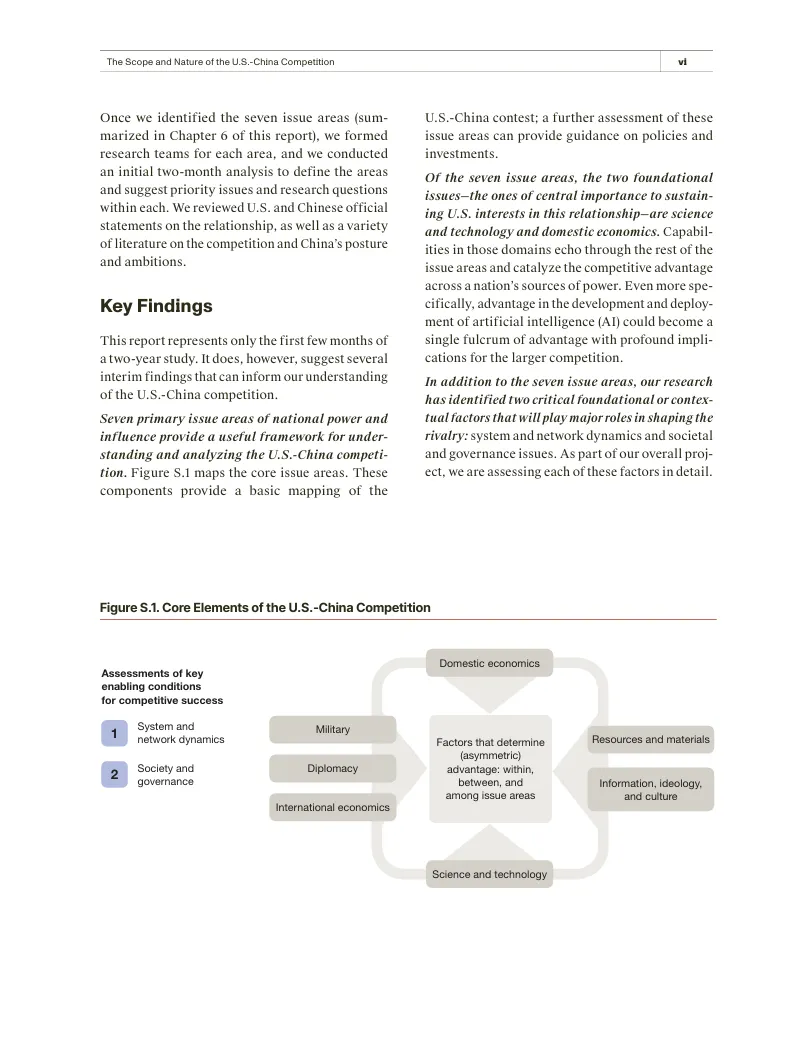
·Seven primary issue areas of national power and influence provide a useful framework for understanding and analyzing the U.S.-China competition.
·Of the seven issue areas, the two foundational issues—the ones of central importance to the future of the competition—are science and technology and domestic economics.
·In addition to the seven issue areas, two critical foundational or contextual factors will play major roles in shaping the rivalry: systems and network dynamics and societal and governance issues.
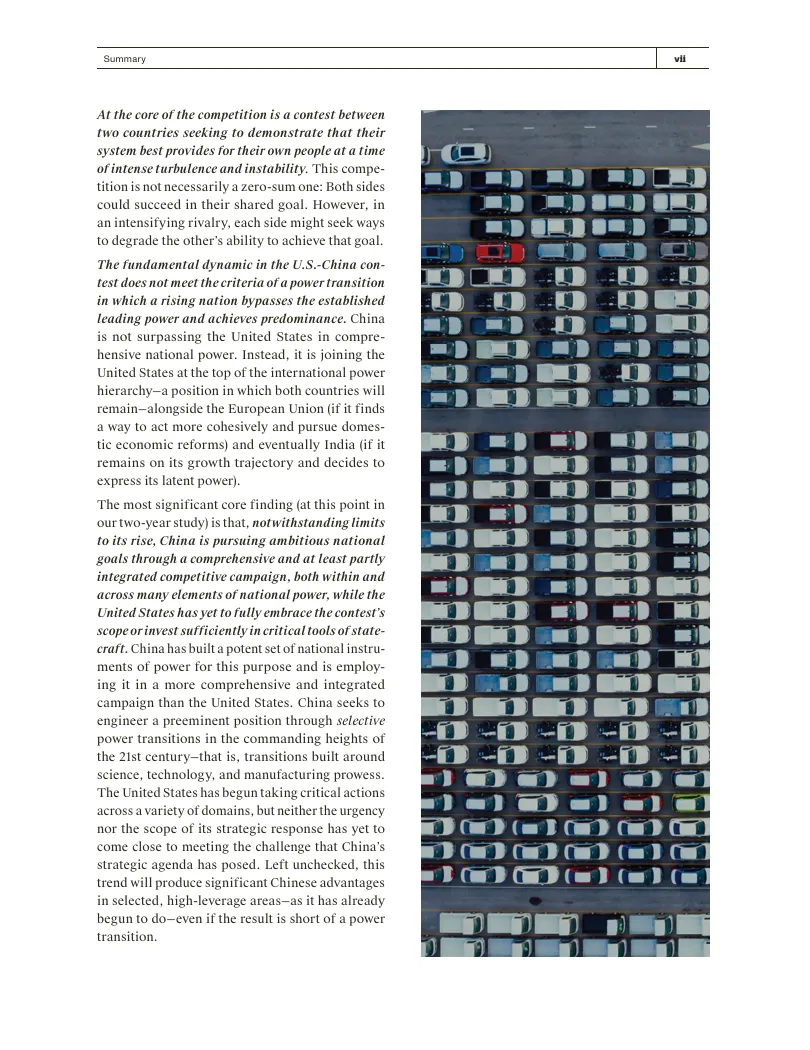
·At the core of the competition is a contest between two countries seeking to demonstrate that their system best provides for their own people at a time of intense turbulence and instability.
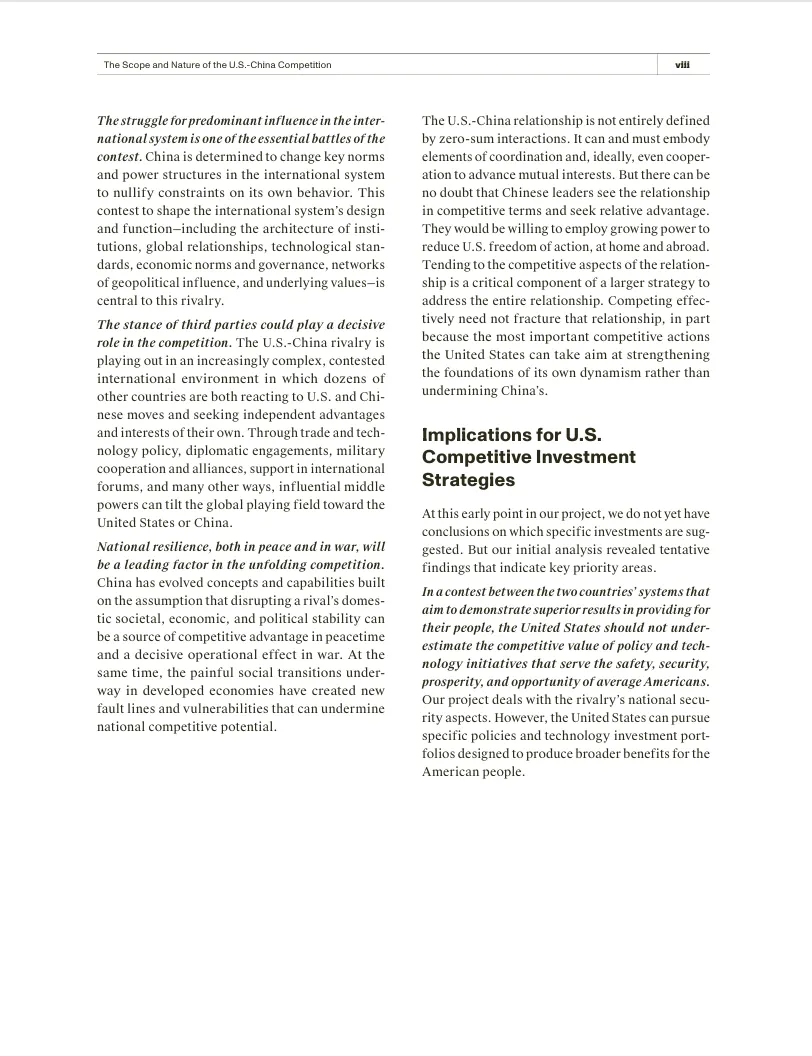
·The stance of third parties could play a decisive role in the competition.
·National resilience, both in peace and in war, will be a leading factor in the unfolding competition.
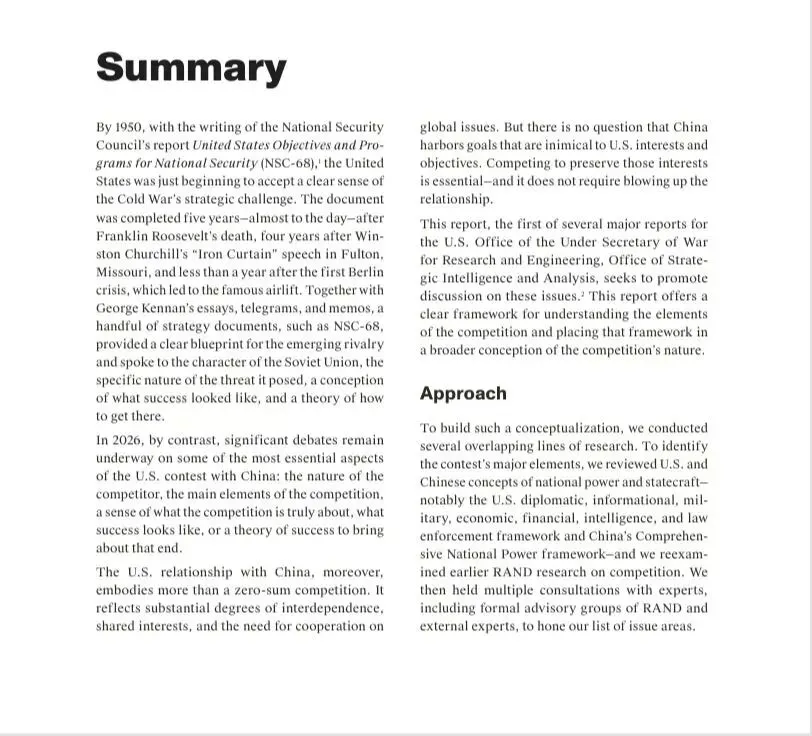
(报告摘要)
Recommendations
·The United States should not underestimate the competitive value of policy and technology initiatives that serve the safety, security, prosperity, and opportunity of average Americans.
·The United States should strengthen existing global power alignments, which remain a leading competitive advantage for the United States and can constrain China’s claims to power.
·The United States should devise and implement technology and policy initiatives in the competition’s areas that fall short of armed conflict but are also ones in which China is focusing on gaining an advantage.
·The United States needs to more highly prioritize policy, regulatory, and technological initiatives to address homeland resilience issues.
·The United States should focus its strategic investments on the contest for influence in global digital and artificial intelligence networks.
·The United States should institute governance reforms and develop new, efficient governing institutions and approaches, which will play critical roles in the competition.
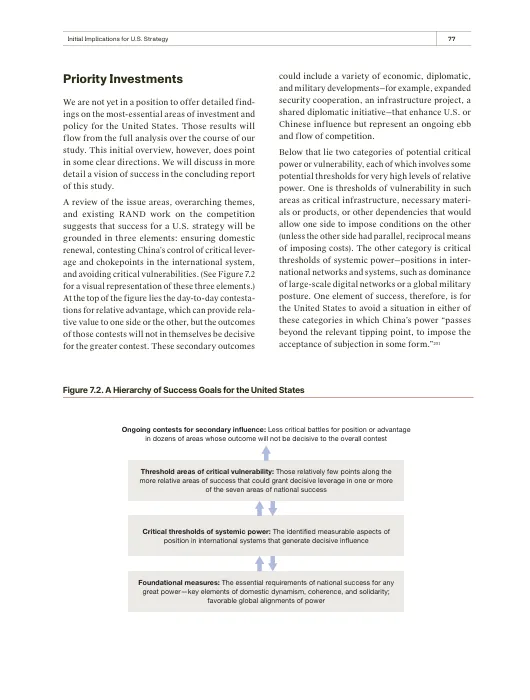
(美国人的锦囊妙计)




发表评论
发表评论: